Cool Easy Toy for Book on Blood Road
You don't get handed the nickname "The Queen of Pain" because you're some kind of Scrabble wizard or ping-pong prodigy. Rebecca Rusch came by that title the hard way. Drowning, dehydration, dysentery, frostbite, hypothermia, and heat stroke were all things Rusch actively courted for years—first as one of the world's preeminent adventure racers and later as one of the toughest competitors to straddle a mountain bike.
And yet the hardest thing Rebecca Rusch ever attempted in her life didn't involve setting another world record or dismantling the field of competition. It was a long ride, sure—1,200 miles and 380 hours spent slogging through unforgiving jungle. Rusch, however, will tell you the physical toll wasn't the worst of it. This ride, which took her to the very spot in Laos where her father died more than 40 years earlier, also took Rusch to a place inside herself that neither she nor her sponsor, Red Bull, anticipated.
The movie, Blood Road, chronicles Rusch's journey through Vietnam, Laos and Cambodia, and if you're expecting Red Bull Media House's first full-length feature film to brim with corner schralping, cliff hucking and the like, you may walk away surprised. This is the story of how Rebecca Rusch wound up on the Ho Chi Minh Trail and what she found there.
No Stranger to Pain
Most mountain bikers first became aware of Rusch as the rider who seemed to come out of nowhere in 2006 and quickly established herself as one of the top competitors in solo endurance racing, undoubtedly one of the most grueling disciplines in existence. But while Rebecca Rusch may have been new to professional mountain biking, she was no newcomer to this suffering thing.
Rusch cut her teeth as a rock climber, quickly made it onto the US national whitewater rafting team and soon thereafter become one of the world's top adventure racers. Events such as the Eco-Challenge and Primal Quest had Rusch and teammates racing camels across the deserts, scaling mountains, hacking their way through malarial jungles in competitions that made for great TV, but were hell on the human body. Moreover, they could also prove downright dangerous. A series of deaths and injuries in high profile adventure races—competitions that Rusch participated in—began to make sponsors and competitors alike question whether victories truly merited the risk.
Public interest in (and sponsorship dollars for) adventure racing eventually began to wane and at 38, Rusch was faced with the question—What next? She had long since passed the age at which most professional athletes pack it in. Instead of retiring, however, Rusch decided to try competitive mountain biking instead. The result? Three 24-Hour Solo Mountain Bike World Champion titles, four consecutive Leadville victories, three Dirty Kanza 200 wins and point-to-point course records on trails like the Kokopelli. Somewhere along the line Rusch picked up the title, "Queen of Pain". The moniker stuck because, frankly, Rebecca Rusch is no stranger to pain. Not all pain, however, is of the physical variety.
Where It All Began
When Rebecca Rusch would think, over the years, about her father, what she often recalled were the letters he sent home from the Vietnam war. Those letters from Da Nang Air Base were almost all Rebecca had to remember him by. Her father disappeared after being shot down over Laos. Captain Stephen Rusch's F4-E Phantom II fighter-bomber was brought down by anti-aircraft fire while completing a strike mission on the Trường Sơn Strategic Supply Route—what Americans often refer to as the Ho Chi Minh Trail. The date was March 7, 1972. Rebecca Rusch was just three years old at the time.
Stephen Rusch's final flight was just one of the 580,000 bombing missions that sought to obliterate traffic on the Trail between 1964 and 1973. The Ho Chi Minh Trail, which is actually a sprawling network of trails, tunnels and dirt roads, was North Vietnam's primary conduit for resupplying its war effort.
Destroy the Ho Chi Minh trail and you'd destroy the communist Viet Minh and Viet Cong armies—that was the United States' thinking and while it may have made strategic sense, it also proved impossible, despite a devastating bombing campaign that lasted nearly a decade.
From 1964 to 1973, the United States dumped more than two million tons of bombs on the trail, most of which ran through Laos. That's the equivalent of dropping a plane load of bombs every eight minutes, 24 hours a day, for nine years straight. It also made Laos the most bombed nation on earth, per capita, ever. More than seven bombs were dropped for every man, woman and child living in Laos at the time.
So many people, civilians and soldiers alike, died during the bombing that the Ho Chi Minh trail earned another name—"the Blood Road".
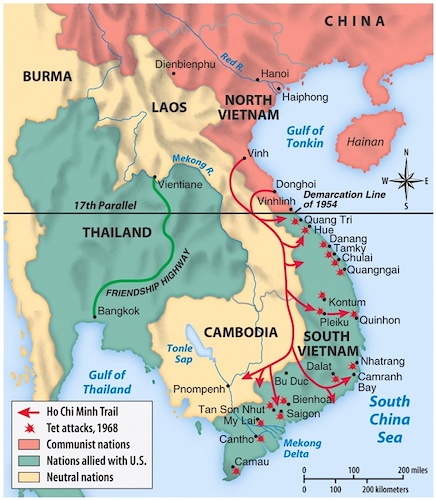
Map of the Ho Chi Minh trail
Gone but Not Forgotten
No one goes through life having lost a parent without also suffering in some way from that loss. Rebecca Rusch was always aware of the vacuum in her life created by her father's absence. There were all those extra hours her mother put in every day in order to raise Rebecca and her older sister, Judy. And there was that gaping hole that exists whenever someone is lost to a family and their fate remains a mystery. The Air Force had delivered the news that Stephen Rusch's jet had been shot down soon after the crash, but the Rusch family could never say for sure what had truly happened to Stephen. Had he died on impact? Been taken prisoner? Was he still alive somewhere out there?
But for Rebecca, there was also this: Her father's absence was a constant in her life. She never remembered a day in her life when Stephen had been there. Yes, there were a few pictures of the Air Force captain and his young family, but what was Stephen like? What kind of man had he been? Rebecca couldn't tell you, much less herself.
It wasn't until Rebecca went to Vietnam in 2003 to compete in the Raid Gauloises adventure race that she really began to grapple with the idea of who her father had been.
"We were there, 10 days in the jungle getting trench foot and dysentery and just dealing with the elements," recalls Rusch "and that was the first time in my life that I could really begin to contemplate what my dad had been through. To physically be in the place, it had me thinking, 'Wow, is this the kind of thing the soldiers faced?' It was brutal."
After the race, Rebecca and her mother visited Da Nang Air Base where her father had been stationed. They went to the battlefield at Khe San. One day the Rusch's guide pointed off into the distance; over there, he told them, lay the Ho Chi Minh trail. It gripped Rebecca. She knew, that somewhere along that trail her father had, in all likelihood, died. He was here.
"Those two things—physically being there in the jungle and visiting places I knew my dad had been—that's the first time I really thought about him in a way that went beyond, 'Yeah, I lost my dad and he's this guy in this picture, but I didn't really know him.' That trip was, I guess, the first time he was really personalized for me."
Rebecca filed away the experience. Her life has always boiled down to moving fast—the next big climb, the next expedition to a far flung corner of the globe, the next starting line. This adventure racing thing was drawing to a close and she was about to dive headfirst into a new one—professional mountain biking, ironic given that it was the one discipline Rebecca Rusch did not excel at and did not actually enjoy at the time. But in the back of Rebecca's mind a plan involving Vietnam was germinating.
Flash forward ten years and Rebecca Rusch, now world-renowned mountain bike racer and anointed "Queen of Pain", found herself pitching one of her sponsors—Red Bull. Red Bull is ostensibly a purveyor of carbonated beverages. After all, they sold six billion cans of the stuff last year alone. Red Bull, however, has also become a media juggernaut in its own right—nearly as famous for the bizarre stunts and stunning videos it produces as it is for producing a bubbly drink that pairs well with vodka. Each year Red Bull pushes its sponsored athletes to deliver novel ideas for their own stories. Rebecca proposed an expedition of the Ho Chi Minh trail; she'd ride the thing tip to tip and find the place where her father's plane went down. In the years since her first visit to Vietnam, the United States Air Force had located Stephen Rusch's dog tags and a few of his teeth. The military had also furnished the Rusch family with maps and coordinates. Most people would have glanced at those topo charts and simply cast them aside.
"Me being an adventure racer?" says Rebecca, "I live to read maps, to explore. When I saw those things, it was like, 'Hmmmmm… I wonder what's out there.'
Red Bull eventually bit on the project. They paired Rebecca with filmmaker, Nicholas Schrunk, as well as a Vietnamese riding partner, Huyen Nguyen. In February of 2015, Rusch landed in Vietnam, bike in tow. Her goal was to reach the crash site on the anniversary of the day he died. In between her and that site were hundreds of miles of unmarked roads and trails, water crossings, border crossings, delays, and some of the most beautiful, yet harsh, terrain imagineable.
Terra Incognita
Rebecca Rusch is not an anti-social person. She's quick to laugh or fill an awkward gap in any conversation. A misanthrope she is not. And yet there's no denying the fact that a part of Rebecca clearly relishes going it alone. For the past decade Rebecca Rusch has largely made her mark on the world, solo. Riding the length of the Ho Chi Minh with another rider? That wasn't Rusch's idea. Nicholas Schrunk, the director, insisted on it. From a filmmaking perspective, it was a sound idea. A companion would provide another voice, another perspective to the journey. And that perspective was key. Both Rusch and Red Bull were aware that the expedition would benefit from the input of a local who could provide a window into the culture. The production arranged to have Vietnam's most successful mountain biker join the expedition.
Huyen Nguyen, it should be said, is no slouch on a bike. Nguyen rode to victory at the Southeast Asia Games no fewer than four times. However, Nguyen was never an endurance racer. What's more, Nguyen retired from professional competition a decade ago. Rusch couldn't deny the logic of having a partner, but at the time the prospect left her uneasy all the same.
"Having Huyen join us was part of the creative decision, really, to combine the cultures," says Rusch. "But it was, honestly, one of the things I was most nervous about."
"To do this thing—the most important thing I'd done in my life—with a complete stranger who doesn't speak my language? And who was a cross-country racer ten years ago! I mean, she was a great racer, but she didn't have expedition experience. She didn't have ultra-endurance experience. She'd been retired for a while now… I definitely went into this with a bit of trepidation. Like, I don't know if she can actually do this."
Riding the Ho Chi Minh is no simple matter. While Rusch's team had scouted the most historically accurate route possible months in advance of the trip, the trail is always in a state of flux. Torrential rains wash out bridges. The trails are constantly growing new spurs, reroutes and offshoots that lead to nowhere in particular. Fortunately, if you're going to be lost in the jungle or atop a mountain, there's no better person to be with than Rebecca Rusch. Wayfinding and wilderness survival are skills she honed over the course of years of weeklong, point-to-point adventure races that traversed some of the harshest and least inhabited corners of the planet. Still, the going was rough at times.
Few riders can keep up with Rebecca Rusch. She's not only fast... she's relentless. And as it turns out, Huyen could not match Rebecca's pace. It would have been a miracle if she had. As the two riders reel off their first few days of riding in Blood Road, you can tell that Rusch is chomping at the bit to go faster. She has a deadline to meet.
While there are no melt downs or impatient glares, the delays do begin to rack up. There are days when Rebecca and Huyen make great time, only to be stalled for hours as they navigate government bureaucracy or wait for permission from local chiefs to pass through their lands.
It soon becomes clear that making it to the crash site on time is going to be a challenge. At first, it's frustrating. In retrospect, however, Rebecca Rusch is grateful for all of it.
"If it had been me alone or me riding with a faster, more experienced partner, I would have gone into my familiar hammer mode," says Rusch. "But I couldn't do that. We had to slow down for the film crew. And sometimes we had to slow down for Huyen. And sometimes the place just demanded that we slow down. That border crossing in Laos? It's just 30 seconds in the film, but it actually took seven hours! That kind of stuff just drives me insane. My normal mode is to just cover the miles as fast as I can, but I had to let go of all that. That's just not the way it works over there. And once I let go of that, it was actually a lot more fun for me. The whole trip became a much fuller experience because I had to slow down."
"Huyen just blew me away," recalls Rusch "She rode above and beyond, but it was more than that. We'd be riding and she'd be explaining to me about how the rice was harvested, or showing me the bomb craters. The typical racer in me, if I were all alone, I would have put my head down and missed so much of what was actually happening."
"Huyen helped me get out of my own way and really experience it," says Rusch. "I feel like I taught her some things—that she is stronger than she thinks she is, that she can ride farther than she thought. But Huyen taught me something about the worth of slowing down... about opening up and looking around."
My whole life has been about going as fast as possible," says Rusch. "And that racer in me is still very much alive, but now there are two sides of me."
The War That Keeps Killing
One of the things that Rebecca immediately noticed—couldn't help but notice, really—as she began to take in her surroundings was the legacy of the war. For starters, the landscape of Laos was completely and permanently altered by the conflict. There are parts of Laos where mountain tops were leveled and valleys turned into a moonscape of craters. Those two million tons worth of explosives made their impact. And, sadly, are still making an impact today.
The bulk of the bombs dropped on Laos were cluster bombs. A cluster bomb is a large canister bomb that splinters before hitting the earth, spewing hundreds of smaller, baseball-sized bombs which rain out in a shower over the land. Each one of those craters is what results when a cluster bomb explodes.
Nearly a third of the 270 million cluster bombs that were dropped, however, didn't explode on first contact and are still strewn across Laos. That's eighty million bombs that could still go off. Tragically, that payload of unexploded ordnance still takes lives every year. On average 50 people in Laos die each year as they come across a cluster bomb. Some years are worse, with as many as 300 civilians falling to the bombs. About forty percent of the victims are children, who often think they've found a toy. Farmers are hit particularly hard. Eighty percent of Laotians still must farm the land in order to eat. They know their pastures and rice paddies are littered with cluster bombs, but it's either risk death or surely starve.
Rusch saw all this on the ride down the Ho Chi Minh and it shocked her.
"I understood the situation intellectually, but seeing it with my own eyes was totally different. It stunned me… Our trash is still over there killing people. Why haven't we cleaned it up? We didn't set out to make an anti-war film," says Rusch, "but once you've witnessed what's still happening over there, you can't distance yourself from that. It was really eye opening, but it also gave me a purpose, coming home. It's time to clean up the mess."
Since returning from Laos, Rusch has been leading rides in Laos and raising money to help with the clean up effort.
"I'm only one person, but I can still do something about this. I can use this film tour and my bike and hosting rides over there to help clean it up and bring awareness to the problem. I can try and close that circle for my dad."
Was it ever awkward or difficult to meet people along the Ho Chi Minh Trail and have them understand your story—that you were there to find your father—when these are the same people your father was, in essence, fighting against? He dropped some of those bombs….
"I was super sad about it," says Rusch, "but also amazed at how forgiving and welcoming the people in Laos, Cambodia, and Vietnam were to us. If someone came to your backyard and their bombs were still there and their parents had been bombing you, we might not welcome them into our homes the way they welcomed us."
"But as sad as it was to see all that devastation," continues Rusch, "it was exciting for me to come home feeling like I could do something with this. Instead of coming home just saddened by the tragedy, I came home feeling like, 'Okay, I know what I need to do now.' And even though that might be a small thing, I know, it still feels good to try to be at least a part of the solution, part of the healing."
Lost and Found
As Blood Road unfolds, it becomes clear that while the miles and the delays and the navigation are all trying factors, the biggest toll on Rebecca Rusch appears to be an emotional one. While Rusch muscled through 48 years of her life without her father, his absence seems to grow more poignant, the emotions more raw, as Rusch and Nguyen neared his crash site. I ask her if that was the case.
"Hmmm…," Rusch pauses to consider the question. "Yeah. Absolutely. The long days in the saddle, the pain cave... that's my comfort zone. It's a kind of meditation for me. That's why I had to ride the Trail. I mean, I could have just taken some kind of transportation to the crash site, but I had to combine what I do—my way of processing things—to even go there."
"The bike riding, the expedition part? Don't get me wrong—it was super hard," says Rusch, "but it was also super familiar. It's what I do. The emotional part? That was new for me."
"As an athlete, you have to be super tough," says Rusch. "Never show any weakness. It's always, 'Don't worry—I've got this.' I've built my whole career on being that person. Being vulnerable? Being open and being exposed? That's definitely not what I've trained to do."
"In fact, I've trained myself to push all those things down," says Rusch. "To lock them away. So the hardest part? It was absolutely the vulnerability—the opening myself up and being okay with feeling emotions around a bunch of people who started this trip with me as strangers and became something else entirely by the end of it all."
That's not an easy thing to do…
"No, it's super freakin' hard!" says Rusch. "I mean, I want to be strong and perfect and, you know, never cry and hurt, but there's something about the hurt that is… necessary or valuable," says Rusch.
"It's like with the bike racing," she explains. "People always ask me, Why do you go so long? What's with the whole Queen of Pain thing? Do you love suffering? It's not that I love pain, it's that I love who I am on the other side of that pain. This emotional kind of hurt that I felt on this trip? It's helped me heal better. It's like re-breaking a bone in your arm that didn't heal right the first time around, so that it can align better."
"Re-opening this whole thing up for my mom, my sister, for me, for my dad's side of the family, for other veterans? It friggin' hurts. It's super hard. But on the end of it, I'm happier," says Rusch. "I'm healing. My family is healing. It is an amazing gift. When you're in the middle of it? Yeah, it hurts. But when you're done, it was worth it because it all hurts a little bit less."
Did Rusch expect that—that this trip would lead to some kind of healing in her own life?
"No, I didn't expect that. You see, I didn't know my dad, so it was super hard to have remorse about him. There was always this feeling of, 'Oh, he sounds like a super cool guy. I wish I'd known him.' That was always that feeling, but not the sense of loss I think I would have felt if my father had died when I was older and had gotten to know him… So I didn't expect to feel as much as I did on this journey. But going there, learning more about the country and learning more about my father…yeah, it was a surprise to me that I was so impacted by it all. I expected to be sad, yes, but it went about ten thousand layers deeper than that."
"I think this trip was a process of getting to know my father. That happened through my mom and sister's stories, through talking with the people who served with him… and through feeling his presence there in Vietnam and Laos… it changed things for me. I mean I expected this trip to be emotional, but I didn't expect to come home a completely changed person with absolute clarity on my life. Who I am, what I've become, what I've been doing with my life this whole time and what comes next. It's clear now."
Much of what Rusch is describing is obvious in Blood Road, particularly at the point when she reaches her father's grave. On March 7, 1972 Stephen Rusch's fighter jet crash landed just outside the village of Ta Oy.
When Rebecca reaches Ta Oy, she meets Ayre, the village's chief and the son of the man who pulled her father's body from the wreckage and actually buried him all those years ago. It's a surreal moment—these two children of those men, coming together again decades later, the war long gone, but still being felt today. Ayre takes Rebecca to the site. It's a heart wrenching moment.
"I came into this trip with my head bowed, a bit sheepish about my journey," says Rusch. "We needed peoples' help when we were over there. We couldn't have made this film without the help of the Lao and Vietnamese people. And they were consistently like, 'This is your mission? Okay, I'm going to help you.' There was no hesitation at all. It was humbling. I mean, Mr. Ayre says it best in the film when he said, 'I want to help Rebecca. She's a good daughter and I would do the same thing if it were my father.' Huyen was the same way—she was so devoted to my mission and, for me, that was a very big lesson in forgiveness and accepting people—despite our histories."
Never Too Late to Heal
It's been more than a year since Rebecca Rusch finally found the place where her father rests. She's on a whirlwind film tour speaking to audiences about her experience at screenings across the country and the world is taking notice—CNN, the Los Angeles Times, USA Today, ESPN, Sports Illustrated have all covered the movie. When I catch up with her following a screening, she reflects on it all.
"I look at the arc of my career and it's clear that I definitely never planned it this way, but all those pieces had to come together in a perfect storm for me to take this expedition," says Rusch. "If I hadn't become an adventure racer and gone to Vietnam in the first place and had all those map and compass and expedition skills… If I hadn't quit adventure racing and started bike racing… If I didn't have Red Bull as a sponsor... this trip would never have happened."
It's, at the very least, a staggering number of coincidences.
"When I look back on it all," says Rusch, "it makes me think that there really aren't coincidences any more. There was something leading me here all along. I feel like all those layers of 'ifs' are, in a way, my dad guiding me, eventually, to go to that spot… to find him."
"This is my father's inheritance to me. His gift to me. I feel like he brought me here to teach me, 'Hey, this is where you've been going with your life. This is where you're going next. I'm proud of you.' It's like all these years of endurance racing he was asking me, 'What are you searching for? Why do you keep doing this?' and I strongly believe I had to do all that for him to teach me. For me to get to this place where he could teach me... and he has taught me, even though he's gone."
"I guess that's why this film is important," says Rusch. "It's about understanding that people who are gone are still very much a part of who we are. They still can teach us. We can still continue to heal. We have to. But I wasn't listening. For 45 years I didn't hear my dad. It took all of this happening for me to open up my ears and listen."
To find out where Blood Road is playing next or to purchase/download the movie, go to bloodroadfilm.com
Source: https://www.pinkbike.com/news/the-hard-waylost-and-found-on-the-ho-chi-minh-trail.html
0 Response to "Cool Easy Toy for Book on Blood Road"
Post a Comment